Introduction
With 34 felonies under his belt, Trump’s no stranger to a criminal record. This begs the question: was the U.S. 's disposal of President Maduro a lawful and strategically-viable move, or just another entry to Trump’s growing list of legally-reprehensible actions. Jokes aside, Operation Absolute Resolve, which took place on Jan. 3, has divided international law experts and foreign leaders, and could have implications that involve the world stage as a whole, not just U.S.-Venezuela relations. In this blog, I will try to assess the legality of Maduro’s capture based on two main questions:
- Was it legal internationally?
- What kind of precedent does it set?
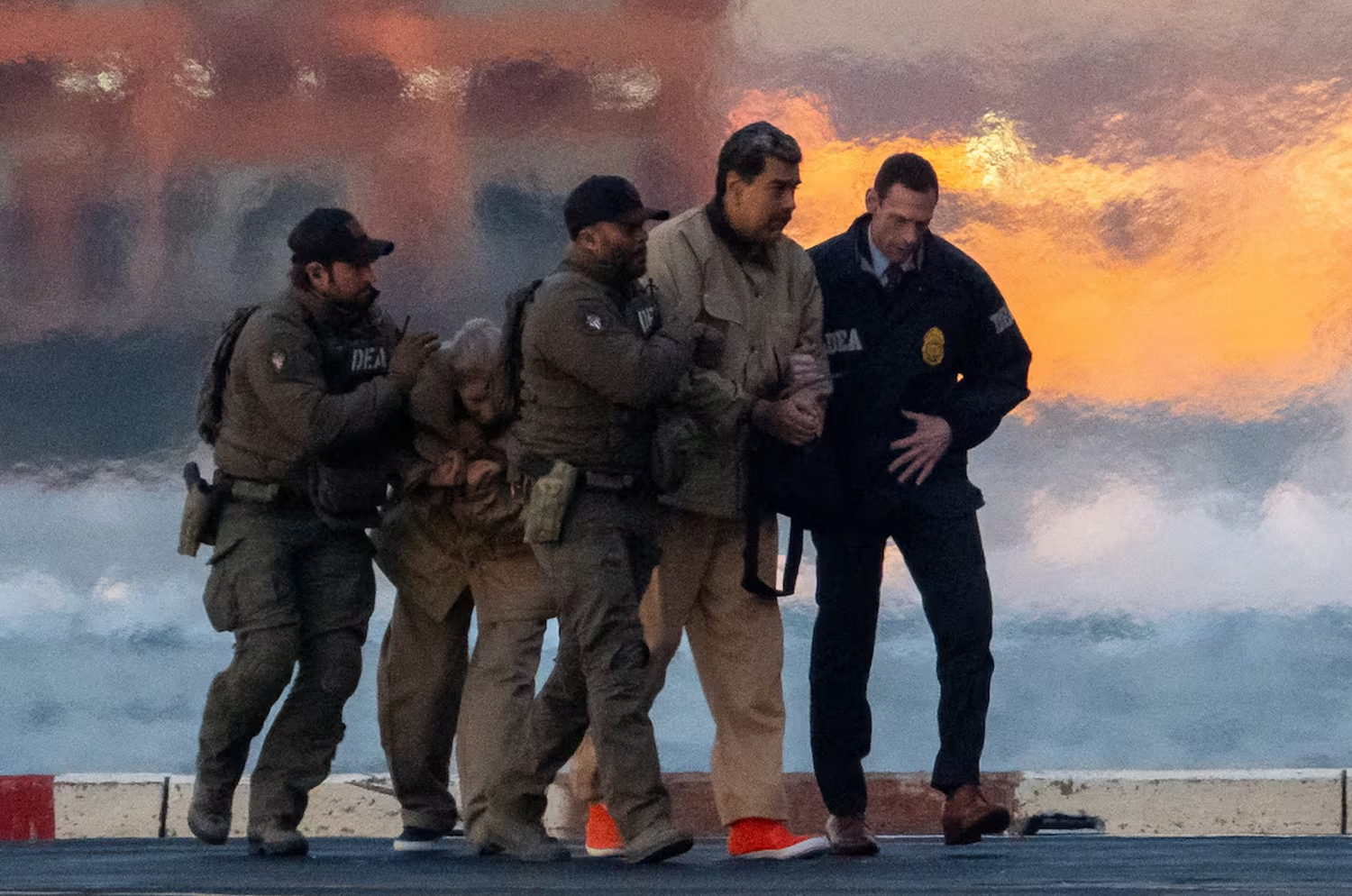
Maduro being transported before a Jan. 5 court appearance. // Adam Gray (Reuters)
Background
The groundwork for Operation Absolute Resolve has been gradually laid since the first few weeks of Trump’s second term. On Jan. 20, 2025, Trump signed Executive Order 14157, which allowed drug cartels, like the Venezuelan Tren de Agua, to be named “foreign terrorist organizations." On Aug. 19, the U.S. military deployed three destroyers off the coast of Venezuela, and within weeks, this force had grown to contain three more ships, around 6,000 soldiers, and several aircraft. Less than a month later, on Sept. 2, the U.S. controversially targeted a small ship that the Trump Administration identified as a “drug-carrying vessel,” en route to the U.S., killing everybody on board. There is still no evidence to corroborate this claim, and it’s believed that the ship was actually on its way to rendezvous with a larger ship that was bound for Suriname. After three more strikes carried out from Sep. to Oct., Senate Republicans struck down an attempt to utilize the War Powers Resolution of 1973 to prevent the president from engaging in hostilities without congressional approval. These early actions became the foundation of Operation Absolute Resolve, the U.S. campaign aimed at dismantling Venezuelan drug networks and pressuring the Maduro regime. Over the following months, the operation expanded to include strikes across the Caribbean Sea and eastern Pacific on vessels accused of smuggling drugs or linked to designated terrorist networks. In all, there have been 36 known strikes since Sept. 2, 2025, resulting in at least 117 people killed as part of the operation’s broader efforts in the region.In all, there have been 36 strikes carried out since Sept. 2nd, killing around 117 people. On Jan. 3, 2026, as part of Operation Absolute Resolve, U.S. forces launched a large-scale military operation in Caracas that culminated in the capture of Venezuelan President Nicolás Maduro and his wife Cilia Flores, who were then transported to the United States to face federal charges.
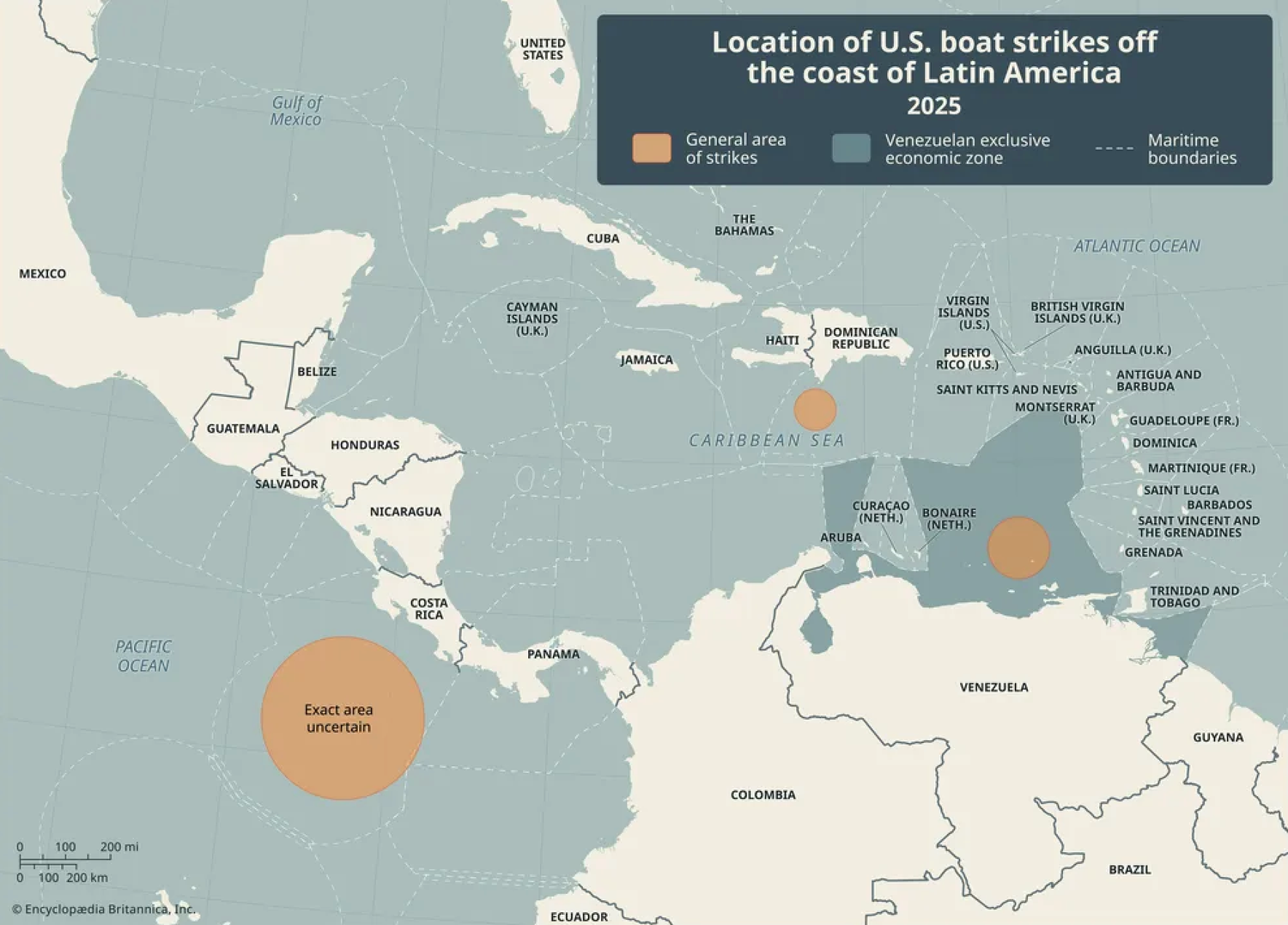
This map shows the location of U.S. strikes on Venezuelan boats. // Britannica
Was it legal internationally?
International law experts and many governments, including China, Russia, and Mexico, have been unequivocal in saying that Maduro’s capture was not legal under established international law norms. According to the UN Charter, the use of force against another state’s territorial integrity or political independence is prohibited. The only exception would be if the U.S. was acting in self-defense under Article 51 of the charter or if they had gotten authorization from the UN Security Council, but neither of these circumstances applied to the U.S.‘s military operation in Caracas. Legal scholars have also emphasized that even serious drug trafficking allegations do not equate to armed attack that would justify a use of force as extreme as what the U.S. did. At the Jan. 5, 2026 UN Security Council meeting, Secretary-General António Guterres said “I remain deeply concerned that rules of international law have not been respected with regard to the 3 January military action,” and that he is “deeply concerned about the possible intensification of instability in the country, the potential impact on the region, and the precedent it may set for how relations between and among states are conducted.” Experts have described the forced removal and transfer of a sitting head of state without consent as an unlawful use of force and a potential crime of aggression. Unfortunately, the U.S. will likely not face punishment for these actions, as the U.S. can veto Security Council action against itself. Nevertheless, the substance of international legal opinion is that capturing Maduro violated tenants of the UN Charter and state sovereignty.
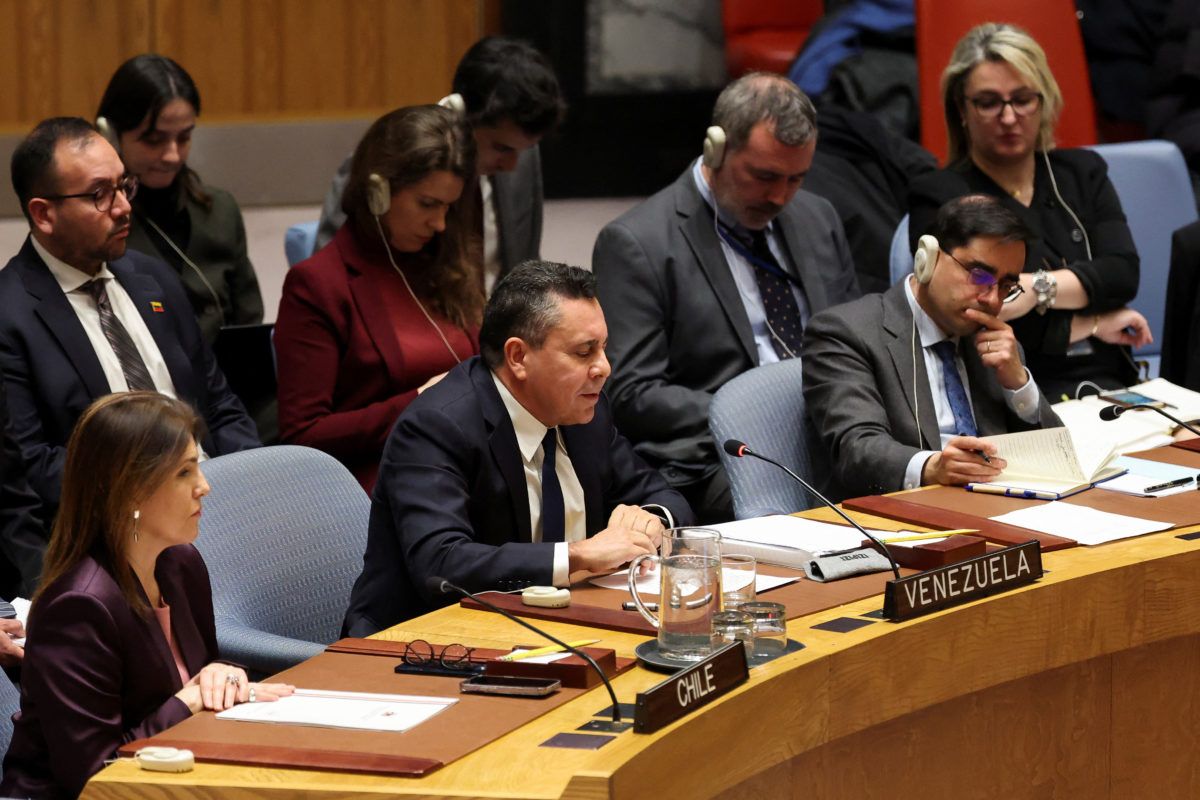
Samuel Reinaldo Moncada Acosta, Venezuela's Ambassador to the United Nations, speaks during a UN Security Council meeting on Jan. 5, 2026. // Brendan McDermid (Reuters)
What kind of precedent does it set?
The capture of Nicolás Maduro is really troubling because it suggests that the U.S. can use military force to arrest a sitting foreign leader without consent or UN authorization. Even if the U.S. tries to chalk up their actions to international “law enforcement,” this operation treads the line between counter-terrorism action and full-on regime change, a controversy that draws parallels to the U.S.’s actions in Afghanistan following 9/11. Furthermore, this weakens the UN Charter’s prohibition on force and undermines state sovereignty. Additionally, It also tells future domestic administrations that they can justify similar raids on foreign territory under undefined executive authority. It also risks encouraging other international states to conduct unilateral operations against leaders they label criminals, which normalizes extra-judicial convictions and makes intervention a more acceptable tool of foreign policy. Some scholars have made the point that if the U.S. can act in this way, they can’t take the moral high ground if China were to invade Taiwan under equally murky circumstances, and that this lack of moral superiority is even inviting China to take action. Matt Kawecki may disagree with this conjecture, however.
FAQ:
Q: Why does international law matter if there’s no one to enforce it
A: This is a valid question, as it seems pointless to have international precedent if no one can stop the U.S. from violating it. In my opinion, international law matters because it creates the rules that keep powerful countries, like the U.S., from acting with complete lack of punishment. Although it’s hard for countries to combat the U.S. militarily, breaking these rules can lead to economic and political punishment, like embargoes and boycotts. However, as the U.S. seems to have gotten away with only a verbal reprimanding this time, it begs the question when, or if, other countries will take more impactful action.
Q: What will happen to Maduro?
A: As far as I can tell, Maduro will likely remain in U.S. federal custody and face trial in the Southern District of New York on charges of narco-terrorism and drug trafficking. Even if his capture is controversial under international law, U.S. courts generally proceed with prosecution once a defendant is in custody. It’s important to note that this process won’t happen quickly, with newspaper El Pais estimating that Maduro’s legal ordeal could last up to two years.
Leave a comment!
Sources
Angell, Katie. "2025 U.S. Strikes on Venezuelan Vessels: When Washington's War on Drugs Reaches Venezuela's Shores." Britannica. Last modified January 1, 2026. https://www.britannica.com/event/2025-US-Strikes-on-Venezuelan-Vessels.
Finley, Ben, Konstantin Toropin, and Regina Garcia Cano. "A timeline of U.S. military escalation against Venezuela leading to Maduro's capture." PBS News. Last modified January 3, 2026. https://www.pbs.org/newshour/world/a-timeline-of-u-s-military-escalation-against-venezuela-leading-to-maduros-capture.
González, Jesús Sérvulo. "Maduro faces a legal ordeal while he waits in the prison known as 'hell on earth.'" El Pais. Last modified January 12, 2026. https://english.elpais.com/international/2026-01-12/maduro-faces-a-legal-ordeal-while-he-waits-in-the-prison-known-as-hell-on-earth.html.
Meriguet, Pablo. "Majority of UN Security Council rejects the US attack on Venezuela." Peoples Dispatch, January 7, 2026. https://peoplesdispatch.org/2026/01/07/majority-of-un-security-council-rejects-the-us-attack-on-venezuela/.
Meyer, Josh. "Trump hailed Maduro capture. Experts call it illegal. Here's why." USA Today. Last modified January 7, 2026. https://www.usatoday.com/story/news/politics/2026/01/07/un-experts-call-trump-maduro-capture-illegal/88017264007/.
Nichols, Michelle. "Legality of US capture of Venezuela's Maduro in focus at United Nations." Reuters. Last modified January 4, 2026. https://www.reuters.com/world/americas/legality-us-capture-venezuelas-maduro-focus-united-nations-2026-01-04/.
University of Cambridge. "The US capture of Venezuela's Maduro: An international legal analysis." University of Cambridge. Last modified January 7, 2026. https://www.cam.ac.uk/research/news/the-us-capture-of-venezuelas-maduro-an-international-legal-analysis.
