9.28.2025
On April 14th, 2013, a special election was held in Venezuela following the death of former President Hugo Chávez. In an incredibly close race, Nicolás Maduro, a former union leader and member of the United Socialist Party of Venezuela, scraped by with 50.62% of the vote. In the decade since, Maduro has seen contested legitimacy, deepening domestic polarization between those demanding his removal and those defending his rule, and escalating tensions with the United States. To understand how Venezuela arrived at today’s impasse, it is essential to trace the evolution of the US-Venezuelan relations under Donald Trump, a period that transformed Maduro from a weakened incumbent into the center of one of Washington’s most volatile foreign policy confrontations.
Maduro’s reign as President has been tainted by both domestic and foreign controversy. Both of Maduro’s reelection bids, in 2018 and 2024, were likely illegitimate due to factors like government involvement, media censorship, and biased miscounting. In March of 2020, during Trump’s first term, the DOJ indicted Maduro on counts of narcoterrorism, claiming that his partnership with FARC (Revolutionary Armed Forces of Colombia) caused “tons of cocaine to enter and devastate American communities.” And from the early days of his second term, Trump has leaned heavily on “maximum pressure” tactics, including broad sanctions on Venezuelan oil, financial blacklists on Maduro’s inner circle, and a reorientation of US Southern Command operations in the Caribbean under the banner of counter-narcotics.
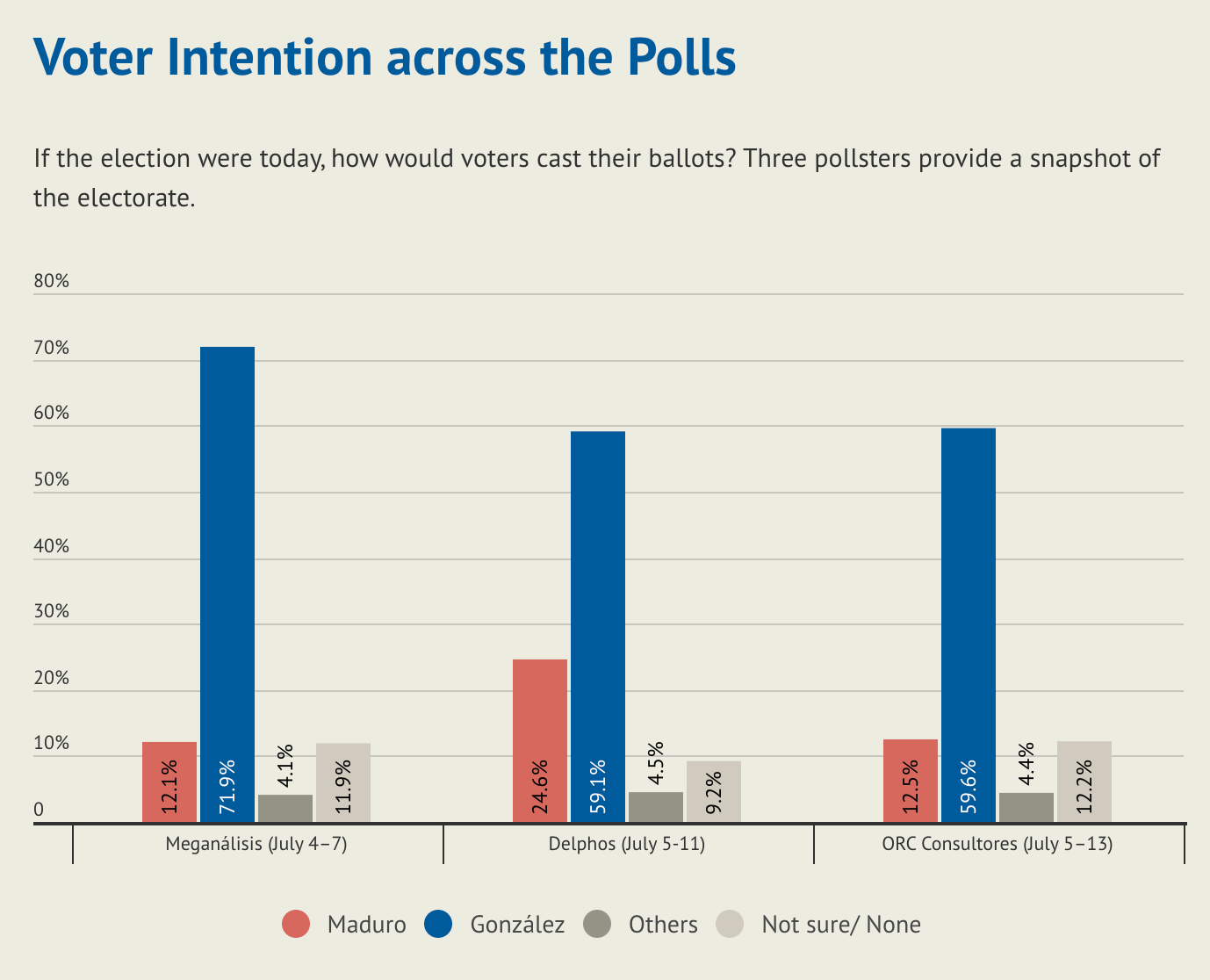
Polls from before the 2024 election suggest Maduro's opposition leads by a large margin. Photo from AS/COA Online
US-Venezuela relations recently made headlines on September 2nd, 2025, when Trump took to X claiming that a US military strike had killed 11 alleged “terrorists” of the Tren de Aragua cartel on a boat likely headed to Trinidad. This action was immediately followed by what the Pentagon called a “highly provocative” Venezuelan response: two Venezuelan F-16s made low passes over a US Navy destroyer operating in international waters, raising fears of further confrontation. The US also moved additional assets into the Southern Caribbean Sea, including around 5,000 sailors, a naval task force, and F-35 fighter jets, arguing that the buildup was necessary to intercept narco-traffickers, while Maduro’s government accused Washington of seeking a regime change.
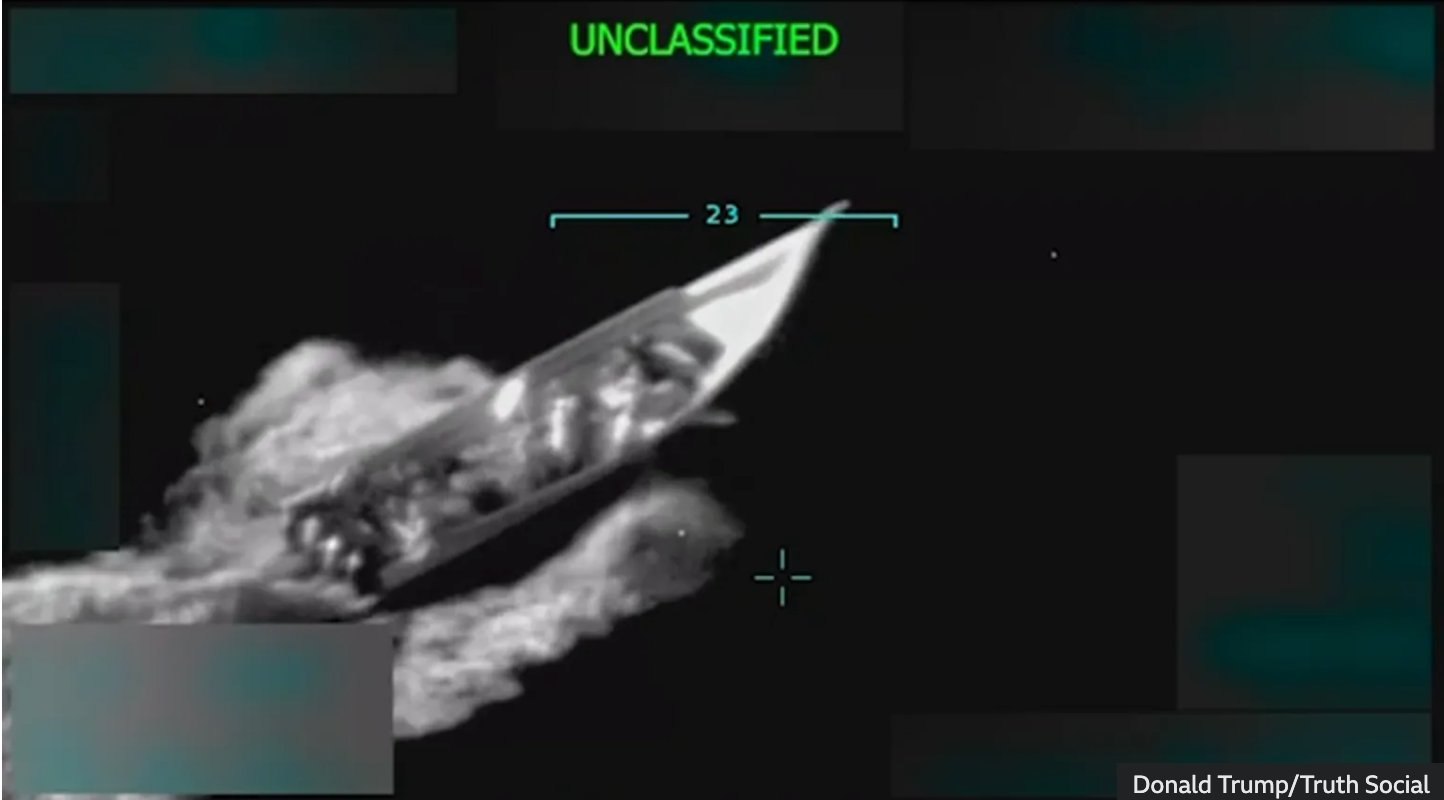
Unclassified footage of the 9/2 strike against a boat of Venezuelan origin. Photo from Donald Trump via Truth Social
As this conflict plays out, I’ve been particularly interested in the pro-government groups in Venezuela, especially the civilian militias. Historically, Maduro has relied not only on the loyalty of his armed forces, but also on a vast network of armed civilian groups, known as colectivos, to handle domestic issues. These colectivos were originally presented as community defense organizations aligned with the ideals of the Bolivarian Revolution, but have increasingly functioned as pro-government paramilitaries. For example, in 2017, amid waves of mass demonstrations against his government, Maduro called on his civilian supporters to arm themselves in defense of the revolution, a move that blurred the line between state security and partisan enforcement. In the current situation, Maduro is once again calling upon these groups.
Although experts say that the US naval presence near Venezuela is far too small to mount a full scale invasion, Maduro has been spreading fear of US attack in what I believe is an attempt to consolidate power even more. Maduro’s government has called up the National Bolivarian Militia, a largely civilian force made up of older members with little weapons training, to prepare for a supposed U.S. assault. By portraying civilians drilling with rifles in the streets of Caracas as defenders of the homeland, Maduro fuels a siege mentality that rallies his base and discourages dissent.
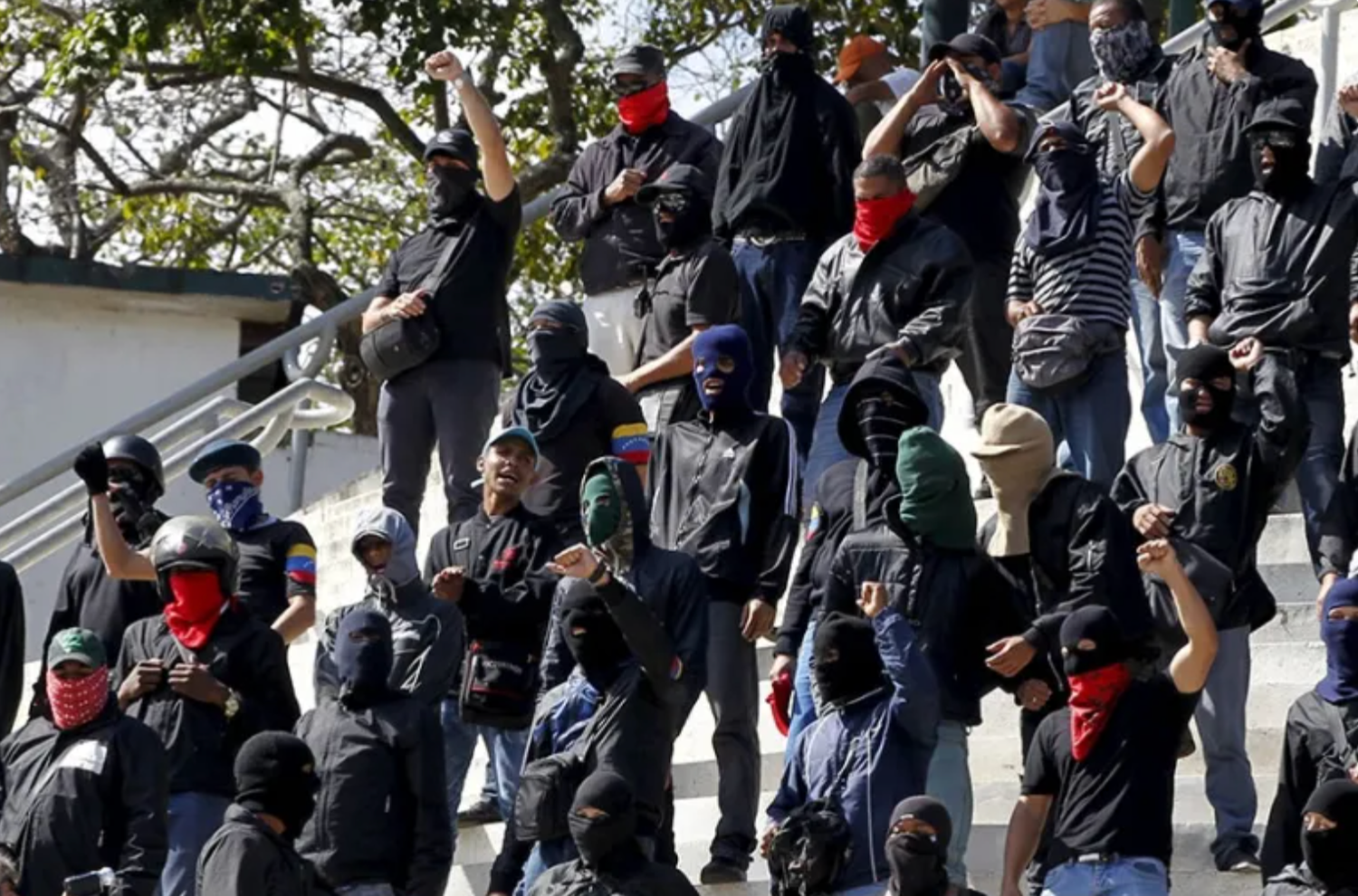
Colectivo members outside of Miraflores Palace in Caracas, Venezuela in January 2016. From Christian Veron, Reuters
Thus, in practice, this narrative strengthens Maduro’s grip at home. Expanding the militia allows him to create a vast, loyal auxiliary force that can double as a political weapon against opposition protests, while the militarization of everyday life diverts attention from economic collapse and corruption scandals. By presenting himself as the only shield against “imperialist aggression,” Maduro is not just preparing for a war that experts doubt will ever come; he is using the specter of invasion to expand state control, intimidate critics, and further consolidate his power even as his legitimacy continues to deteriorate.
Furthermore, the negative publicity resulting from killing any members of this fanatical force, which Maduro has claimed to have over 8 million members, is presumably designed as a deterrent to any of his foes. Thus, the actual military effectiveness of the militia doesn’t matter because they are essentially being used as a human shield.
By casting militias as defenders of the homeland, Maduro has turned them into both a political weapon and a human shield, making their symbolic power more important than their battlefield strength. It is a reminder that in Venezuela’s standoff with the United States, the struggle is less about military force than about how fear and self-justifying narrative can sustain a leader long after legitimacy is gone.
Leave a comment!
Sources
Poll Tracker: Venezuela's 2024 Presidential Election, 5.30.2024, Chase Harrison, AS/COA
US conducts ‘kinetic strike’ against drug boat from Venezuela, killing 11, Trump says, 9.2.2025, Tom Phillips, The Guardian
Venezuela: Who are the colectivos?, 5.9.2019, Lucia Newman, Al Jazeera
Evidence shows Venezuela’s election was stolen – but will Maduro budge?, 8.6.2024, Tiago Rogero, The Guardian
Nicolás Maduro Moros and 14 Current and Former Venezuelan Officials Charged with Narco-Terrorism, Corruption, Drug Trafficking and Other Criminal Charges, 3.26.2020, US Department of Justice
Maduro Rallies 8 Million Venezuelans to Fight U.S., 9.5.2025, Amir Daftari, Newsweek
Fear and Hope in Venezuela as U.S. Warships Lurk, 9.28.2025, Julie Turkewitz, New York Times
The US navy killed 17 in deadly strikes. Now Venezuela is giving civilians guns, 9.27.2025, Nicole Kolster, BBC
